Until this week most of the city’s special buildings held the same handful of things. A hospital, a gun shop and a police station had no rule of their own, so they fell through to the one that covers everything and dropped food and scrap. Only homes and shops had a mix of their own. This week the shelves got stocked.
A building holds what it would hold
The rule now is the obvious one. A place holds what that kind of place would hold. A pharmacy has painkillers and bandages. A hardware store has tools, nails and planks. A grocery has produce and dairy, a convenience store has drinks and beer, a diner has burgers and cake and a kitchen knife in the back. A gun shop has guns and rounds. A bar has alcohol. A florist has garden tools, a laundromat has bleach, a vet has dog food, a music store has guitars. Almost every kind of building in the City entry’s roster has its own line now.
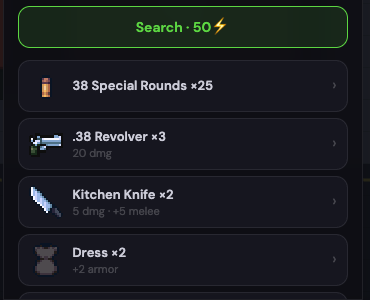
Homes vary by kind. A house has garage things, sports gear, sometimes a guitar. A townhouse has wine and takeout. A duplex has beer and cans. An apartment has takeout and a flashlight and fewer weapons. A farmhouse, out past the ring road, is one of the few homes where a gun is plausible, and a suburb house has a small chance too, because that’s where they are.
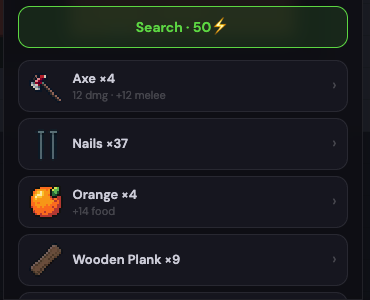
The reason is the one from the City entry: the zone map is a loot map. If a survivor can look at a street and know what it holds, choosing where to go is a real choice.
Guns are a ladder
Guns get their own rule because they’re the thing that changes a fight most. They’re prominent in exactly the places you’d expect, a gun shop, a police station, a surplus store, the military base, the prison, and a guard’s sidearm in a bank. Hardware stores and workshops hold tools, not pistols. Everywhere else a gun is a rare surprise. So the way to arm yourself is to go to where the guns are, and where the guns are is where the doors are locked and the zombies are thickest.
Better toward the centre
The last change is a gradient. The dense middle of the city, and the military base, skew what they hold toward the rare end, and hold a little more of it: the same search that turns up a kitchen knife on the edge of town turns up a vest or a rifle downtown more often. The rare tier itself got deeper this week, so there are things worth building a plan around, and they live where the danger is.
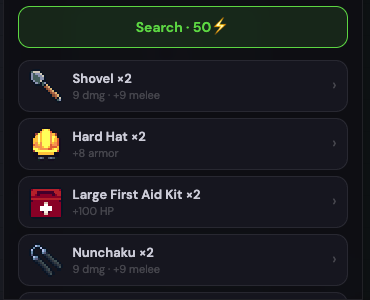
Put together: the edge of the city is safe and poor, the centre is dangerous and rich, and the special buildings are the reason to go anywhere in particular.
Per building, not per room
One thing about this I’m not happy with yet. Loot is decided per building. A gun shop is a gun shop on every floor, and a house is a house in every room. A building-wide rule lands everywhere in the building. The gun shop above turned up two dresses for another reason: its rule asks for armor, and ordinary clothes still counted as armor. A house has a kitchen with food in it and a garage with a shovel in it, and a survivor who’s learned that should be able to search the kitchen for food. That needs rooms, and rooms are a bigger change than a week.
The other open question is whether the gradient is steep enough to matter. If the edge of the city holds enough to live on, nobody goes downtown, and downtown is where the game is. If it holds too little, the first day kills everyone before they’ve found a bat. I’ve picked a slope by feel, and where people die, on the way in or on the way out, will say if it’s right.