The Dying entry said: you die, you come back, and the thing that used to be you keeps your gear. Two of those three are still true. This week the middle one went. You don’t come back.
Gone for good
When your survivor dies you get a short screen. Their name, how many days they lasted, how many zombies they put down, how far they walked. A line that says what happens to the body. And one button, which makes a new survivor on the same account. There is no respawn, no second chance, no waiting out a timer to be the same person again. The name is gone with them. The Making your survivor entry said a name is for keeps; now the survivor is too.
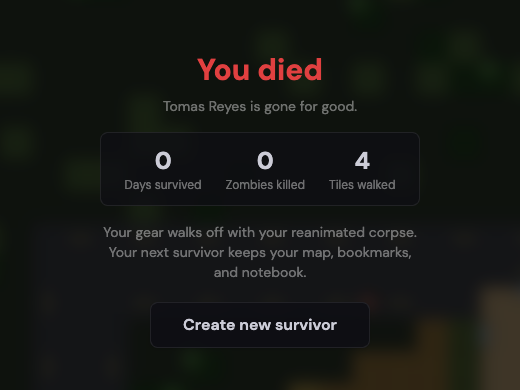
The body stays. It no longer stands up a moment later; some hours after you die, up to half a game day, it gets up as a zombie, wearing what you wore and carrying what you carried, and it walks the street where you fell. The friend who finds it knows.
The new survivor starts tired. Dying is not a way to refill the bar. If it were, the fastest way to get a full day’s energy would be to walk into a crowd. Food no longer does it either: nothing you eat or drink puts energy back now, so only time fills the bar.
What survives is you
There is an account underneath the survivor that outlives them, and everything a player learns lives there, not on the character.
The map you explored is yours. Open the full map and it shows the city painted only where you’ve been: the streets you walked, the buildings you saw, the blocks between them still black. Your second survivor opens the same map and sees the same painted patch, because it was never the survivor’s map.
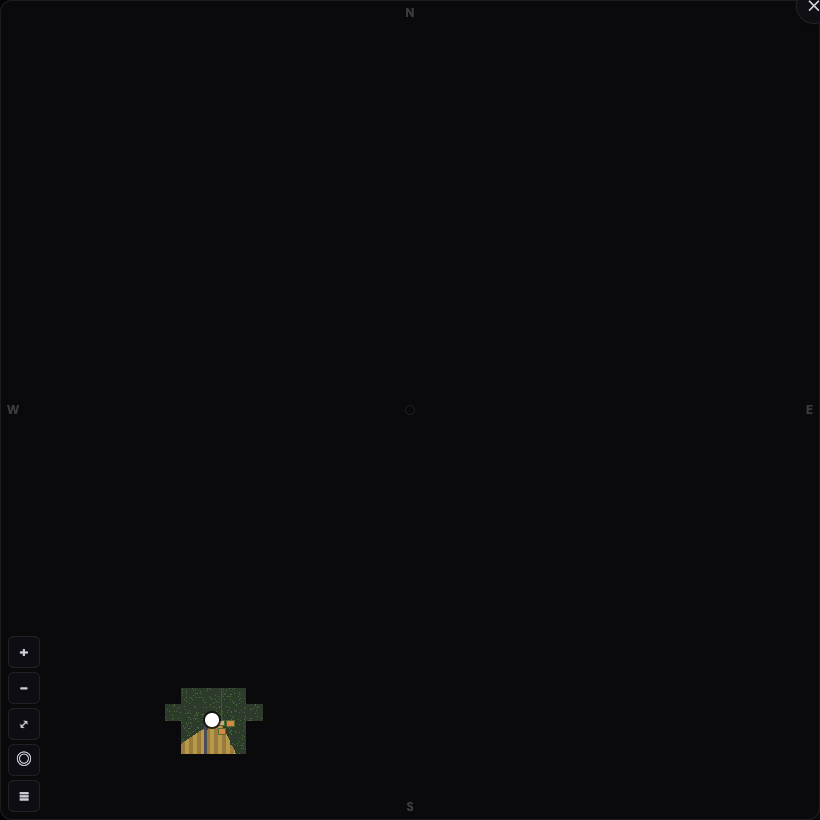
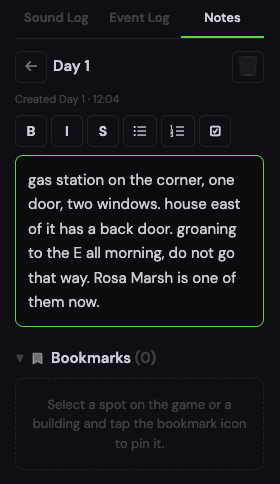
The notebook is yours. It’s a page you write on: what a building held, which door was locked, which way the groaning came from, who’s a zombie now. The bookmarks are yours: pin a place from the tap menu and it shows as a marker on the minimap, and by name under your notes. When the survivor who wrote the note is dead, the note is still there for the next one, in the same hand.
The reason is the one that runs through every entry: everything that makes you stronger is gear, and gear dies with the body. The player who knows the city should be better at the city, and the way to make that true without levels is to let the knowledge live somewhere the zombies can’t reach.
Everything that happened
The last thing that survives is a record. Every energy-costing thing your survivor did, every step, every swing, every door opened or broken or boarded, every search, and every thing done to them, every bite, every breach, every fight-off, goes into a log on the character, in order, and only the oldest lines ever drop off. Movement folds into one line per trip so it doesn’t swamp the rest. When you come back after being away, a divider marks everything since you last looked, and a banner says something happened while you were gone if it did.
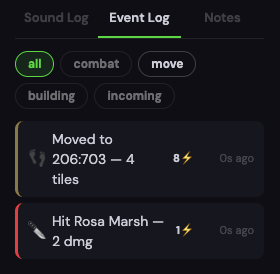
I built this for the check-in game: when you open the tab after six hours you need to know what happened to your character while you weren’t there, and “you took some damage” is not an answer. The three counts on the death screen are tallies the survivor keeps from its first step.
Two things I’m not sure about. A permanent map and notebook may make the second survivor too strong: they know where the hospital is, the first one didn’t. I think that’s the point, but it means the first survivor in any city has the worst day of anyone who’ll ever play there, and that day has to be survivable. And “gone for good” may be too much for a first night. A player who dies in the first hour, before the map has a patch on it or the notebook has a line, loses a name and gets nothing back. The account is meant to be the cushion.