The look entry was about what you can see. This one is about what you can’t, and that half is a rule, not a picture.
The ring and the wedges
The game decides what each survivor can see and sends only that. Your screen is not a window onto the city. It’s a report of what your character’s eyes reached, and a modified client can’t see through a wall because what’s behind the wall was never sent. The lit circle around you is how far you can see on open ground. Inside it, anything a building blocks is dark. Behind every house the ground is cut out of the circle in a dark wedge, and that wedge is exactly where a zombie could stand without being on your screen. It has no idea you’re there either, which is why going round a corner works.
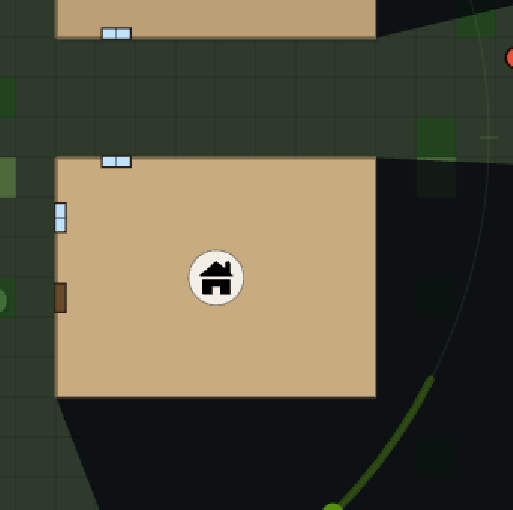
The lit circle shrinks at night, which the Night entry covers. It’s the same street, the same houses, the same rule, drawn smaller and bluer.
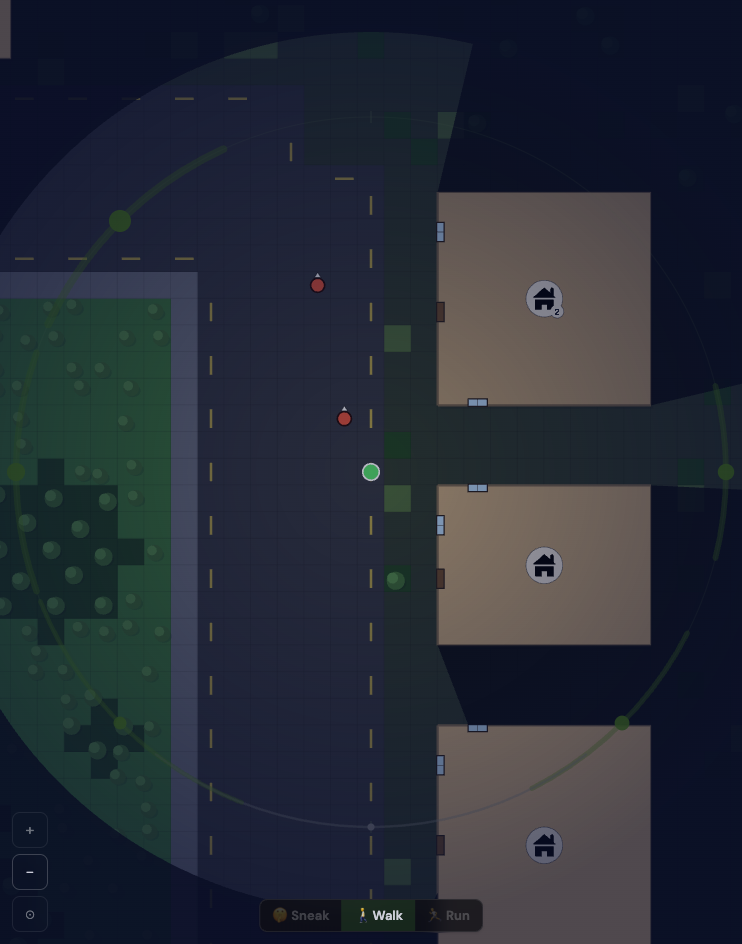
What I hadn’t drawn properly until this week is how sight meets a building. Line of sight used to poke in through a door or a window and light up tiles inside, so a building looked like a box with a bright cone in it, as if you could see through the wall. Now a building is one exterior. You can see it or you can’t, and you never see into it from the street. What’s inside is what the Buildings entry said it is: something you find out by going in.
What you see past the lit circle is the map, not the world. The streets and the blocks you’ve scrolled to are known geometry, the city is not a secret, so you can plan a route across town from the map. But nothing on it is alive: no zombie, no survivor, no body. Everything outside your sight is a plan. Only inside the circle is it news.
Inside, looking out
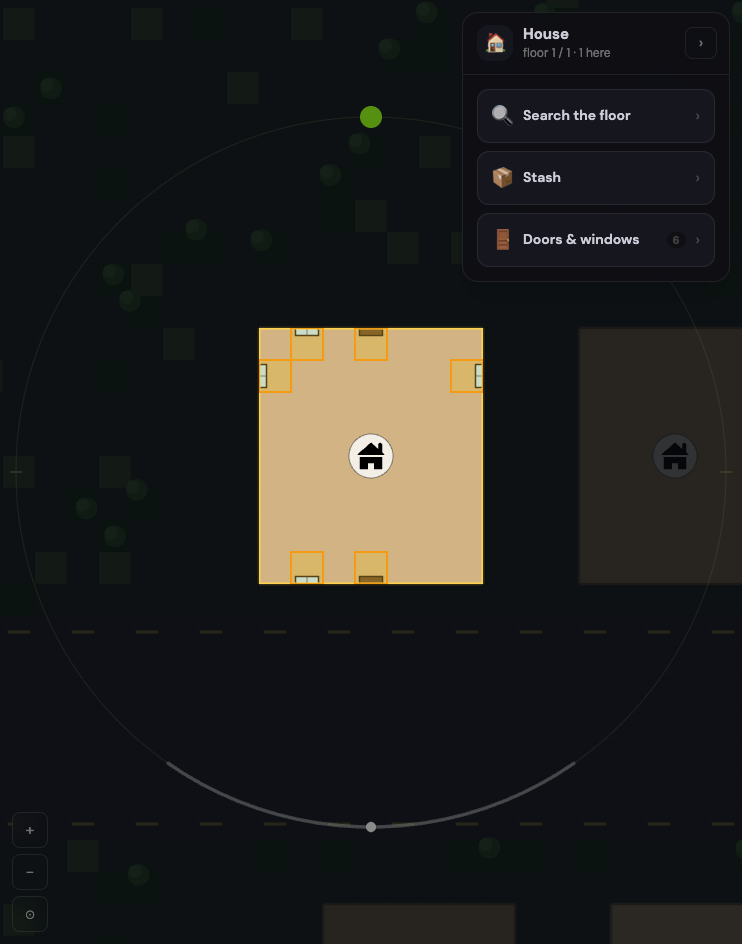
From indoors the same rule runs the other way. Step through a door and the building you’re in is the only lit thing on the map. The street you were just standing on goes dark. That is the blind spot from the Buildings entry drawn literally.
Then you go to a wall and look out. Tap a window and it offers three things: look outside, step outside, or board it up. Looking costs a little energy and opens a cone through that wall, and whatever is out there in the cone is live again for as long as you keep looking. One window shows you one slice of the street. To see all four sides you pay four times, and you still won’t see what’s straight behind the neighbour’s house.
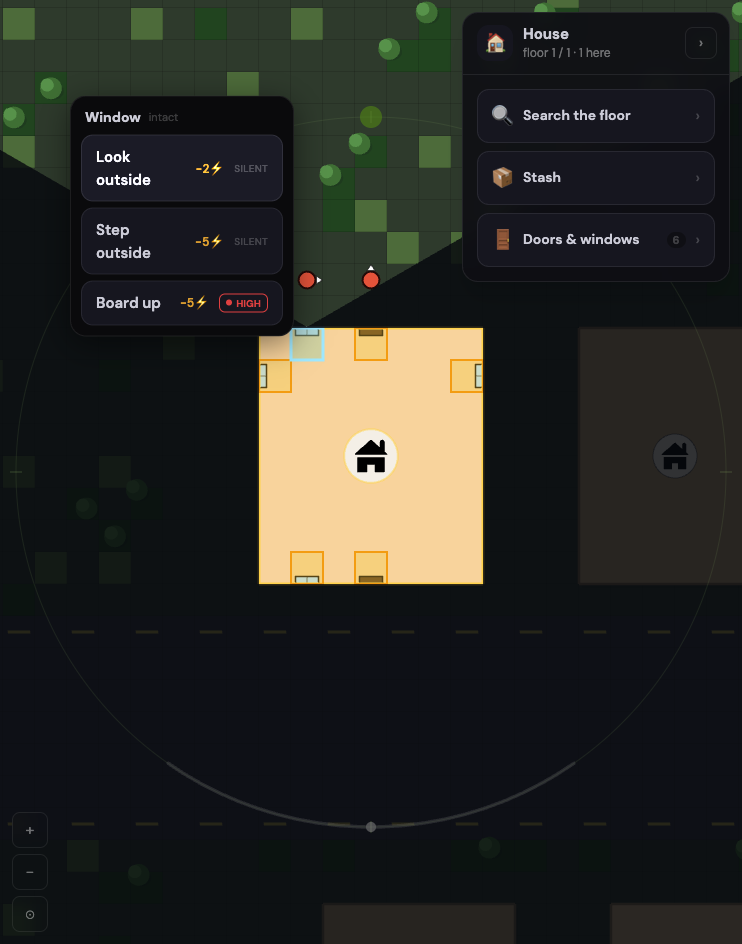
That’s the trade the building offers, drawn on the map. Inside you hear nothing and see nothing. A window gives you back a slice of sight at a small price, and the price is paid in the same energy that gets you home.
The edge
The last thing to go in was the edge of what you can see. Until this week the dark came in as a staircase of tiles, which is what the rules compute and was ugly at any zoom. Now the edge of sight is a clean curve that bends around corners the way sight does. The rules didn’t move; the picture stopped lying about their shape.