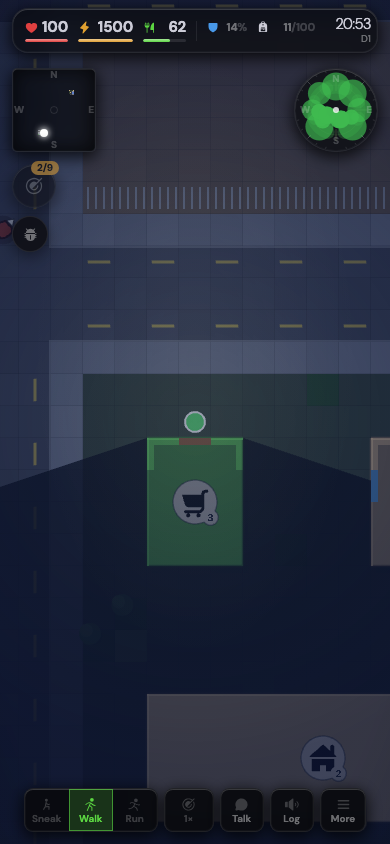
The phone entry set the rule: the map is never covered. I kept the rule and then spent a month adding things around the map, until the map was a window in the middle of a page. A bar across the top, two opaque boxes in the top corners, a stack of zoom buttons down the left edge, five different shaped things along the bottom. This week I threw the layout away and built it again from the map outward.
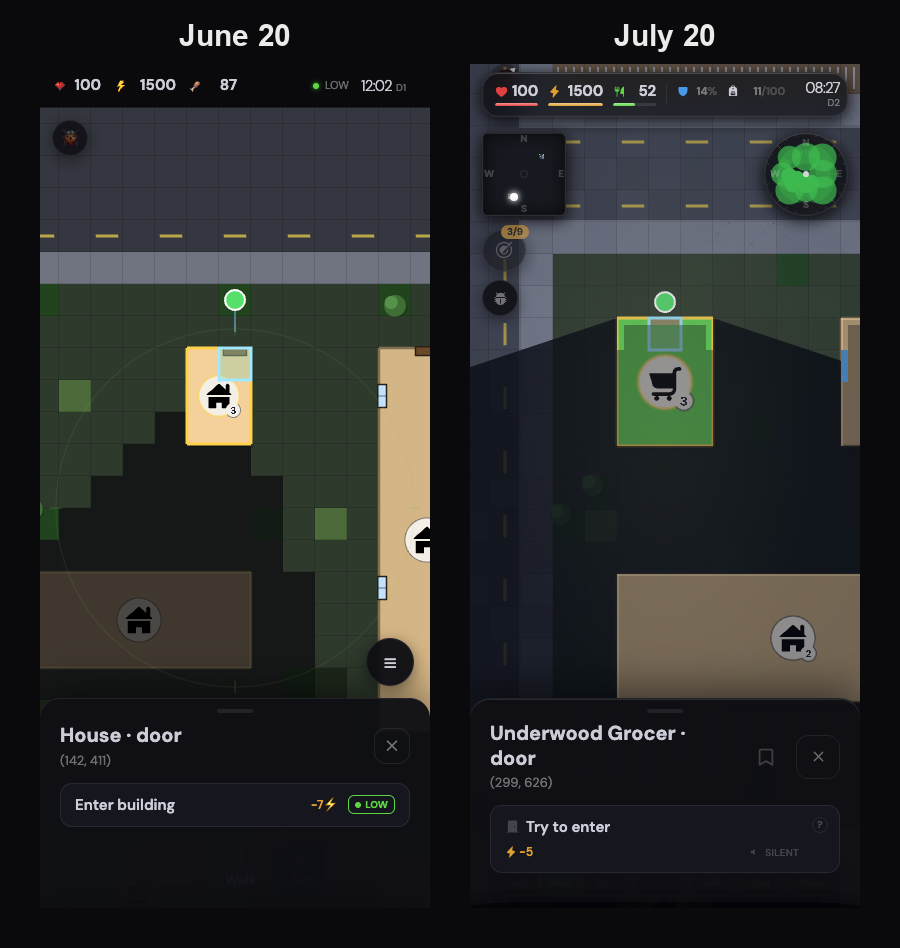
The map goes edge to edge
The top bar was the biggest tell. The hard line under it said “web page with a game inside it”. The bar is gone. The vitals are a small card that floats over the map, and the map runs to every edge behind it. The things you read are translucent, so the world shows through them, and have hard corners. The things you press are nearly solid, so they stay legible over a bright street, and have soft corners, so your eye never confuses an instrument with a button.
Gauges instead of digits
The old vitals were five icon-and-number pairs at the same size and weight. Health runs to a hundred and energy to fifteen hundred, so “am I in trouble” meant reading digits and remembering the scale. Each vital now sits over a thin line that drains as the number drops. Armor and carry keep the same slot but get no line, and having no line is what says “this is not something that runs out”.

One row for the thumb
The bottom of the phone screen had grown into a collection: a stance pill, a fire cadence toggle, a talk button, a round menu button, a zoom stack. They are one row now, the deck, every control the same kind of chip on the same baseline. Sneak, walk, run. Fire cadence. Talk. The log, with a badge when there is something you have not read, because the log is the game’s whole feedback channel and it was two taps deep behind a menu. And More.

The zoom buttons are gone from the phone; pinch and drag already do that. Recenter stays, because there is no gesture for it. I tried floating the deck above an open sheet so the controls would ride up with it. It played badly: it ate the one strip of map you could still see. The deck is pinned now and most sheets cover it, and a small cadence toggle comes back at the top of the map while it does.
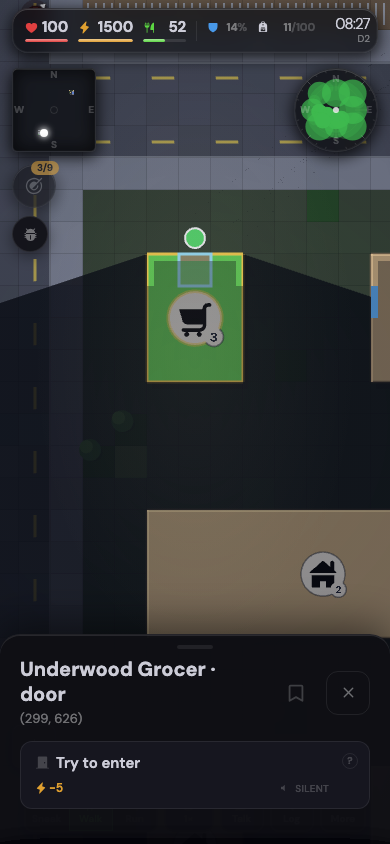
Sheets open at sixty percent of the screen and stop there, with the map live above. When a sheet has more in it than fits, you can pull the handle up and it grows to almost the whole screen. That is a choice you make with your thumb, never something the screen does to you. The big map and the sound map open tall from the start, because they are the map.
One fix in this pass matters more than its size. A tap on the map with certain sheets up used to fall through and fire an action on the tile under it. You reached for “get me out of this sheet” and paid noise and energy to walk somewhere. The map tap now closes the sheet and does nothing else, every time, whatever was open.
Conditions, and the edge of sight
Overloaded and poisoned used to be word chips in the top bar, and two of them pushed the clock off the edge of a narrow phone. They are dials now, in a column under the sound radar, growing downward into space that exists. Tap one and it tells you its name, and, where the game knows them, what it does to you and how long is left.
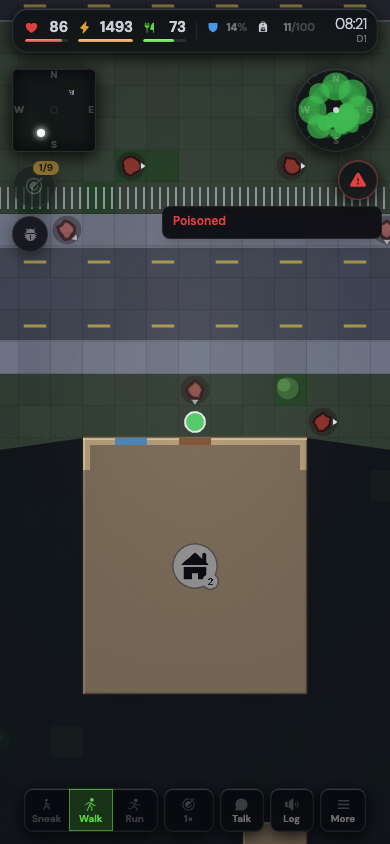
The sight edge got a set of small fixes that together change how the city reads. The buildings inside your sight are now brighter than the ones outside it, so a glance tells you what you have eyes on. Indoors, the range of your sight used to jump around as you walked, because the screen was guessing it; the game now tells the screen the real range. And the sight edge no longer draws a dark band across a floor: it fades into whatever veil it actually meets.