I spent the week writing instead of building. The document I keep for myself runs to pages of tables and numbers I will mostly throw away. This is the short version, the rules I’m fairly sure about and the ones I’m not.
The city
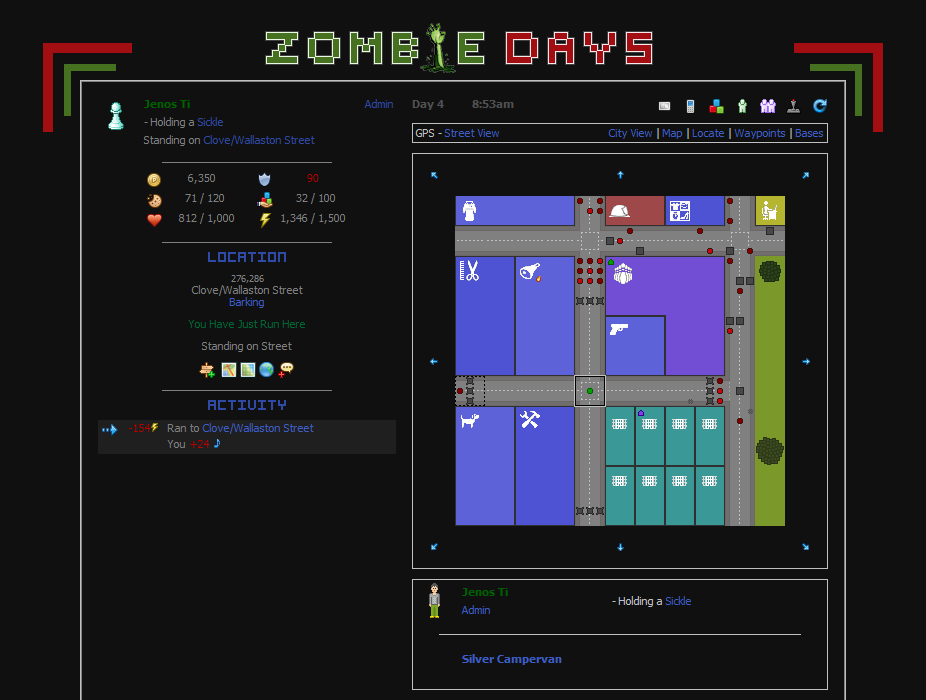
It’s a browser game. You open a page on your phone or your computer and you’re in. Zombie Days was a desktop game in practice, with a rough phone version, and I want the phone to be a first-class way to play this time.
A city keeps running whether you’re there or not. Time passes, zombies move, other people come and go, and your character stays where you left it (I wrote about why in the first entry).
Buildings are searched, not walked through. For now a building is a list: you go in, pick a floor, spend energy searching it, and see what it holds. Inside, the outside sounds muffled, so a house is both a refuge and a blind spot. Real rooms you walk through are a maybe, for later.
There is no day and night yet. The list is already long enough to get wrong.
You
When you die, you become a zombie. Your character gets up wearing your gear and joins the others. If you want that gear back, you have to find your zombie and kill it. Most of the other rules lean on this one.
Because your character stays in the world when you log off, you can’t leave a fight by closing the tab. So the question “how do I sleep safely” has one answer: a boarded-up building. Boarding up a house is how you survive being away, not a side activity.
Energy pays for everything, the way it did in Zombie Days. Every step and every swing costs some, and it only comes back with time, up to a fixed daily amount. Someone who checks in twice a day and someone who never closes the tab get the same energy. That is the fairness rule.
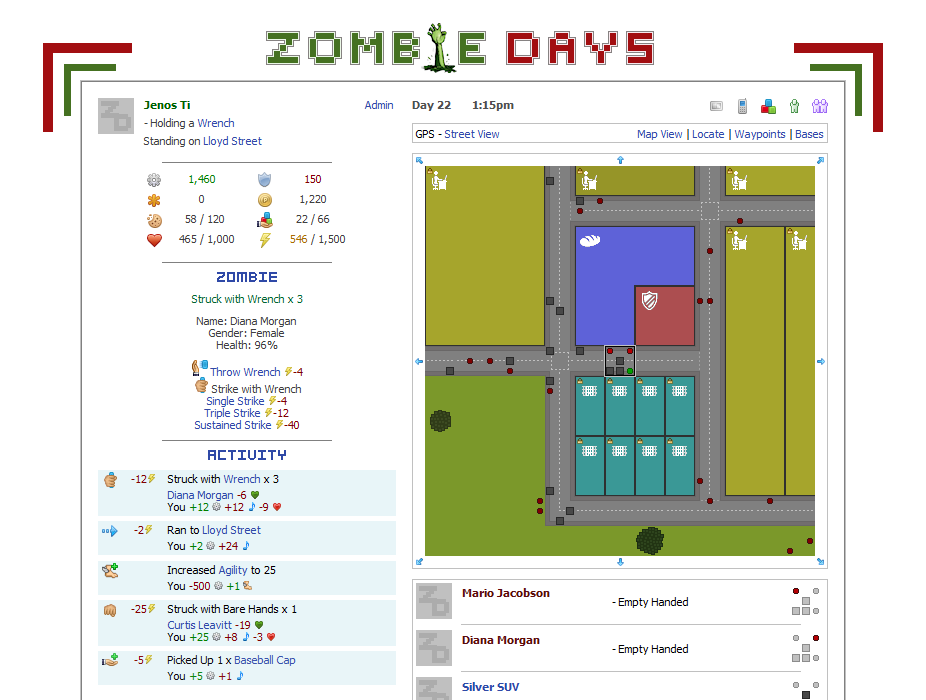
Hunger and thirst are the clock. They go down while you play and, slowly, while you’re away. If you leave well fed you can be gone for days. A character nobody comes back to starves, dies, and gets up in its own house. That is also how the city gets rid of the people who quit, and I already expect to argue with myself about it: a slow death for someone who went on holiday is tidy on paper and might feel cruel in practice.
Everyone starts the same. No classes, no levels, no skills that grow. The only difference between two survivors is what they’re carrying.
Noise
Every action makes noise, and noise travels. Zombies follow it. Other survivors who want what you’re carrying follow it too. Running, fighting, hammering on a door, all of it tells the street where you are. Moving quietly has to be a real choice with a real cost. This is the part I’m least sure about and the part I most want to find out.
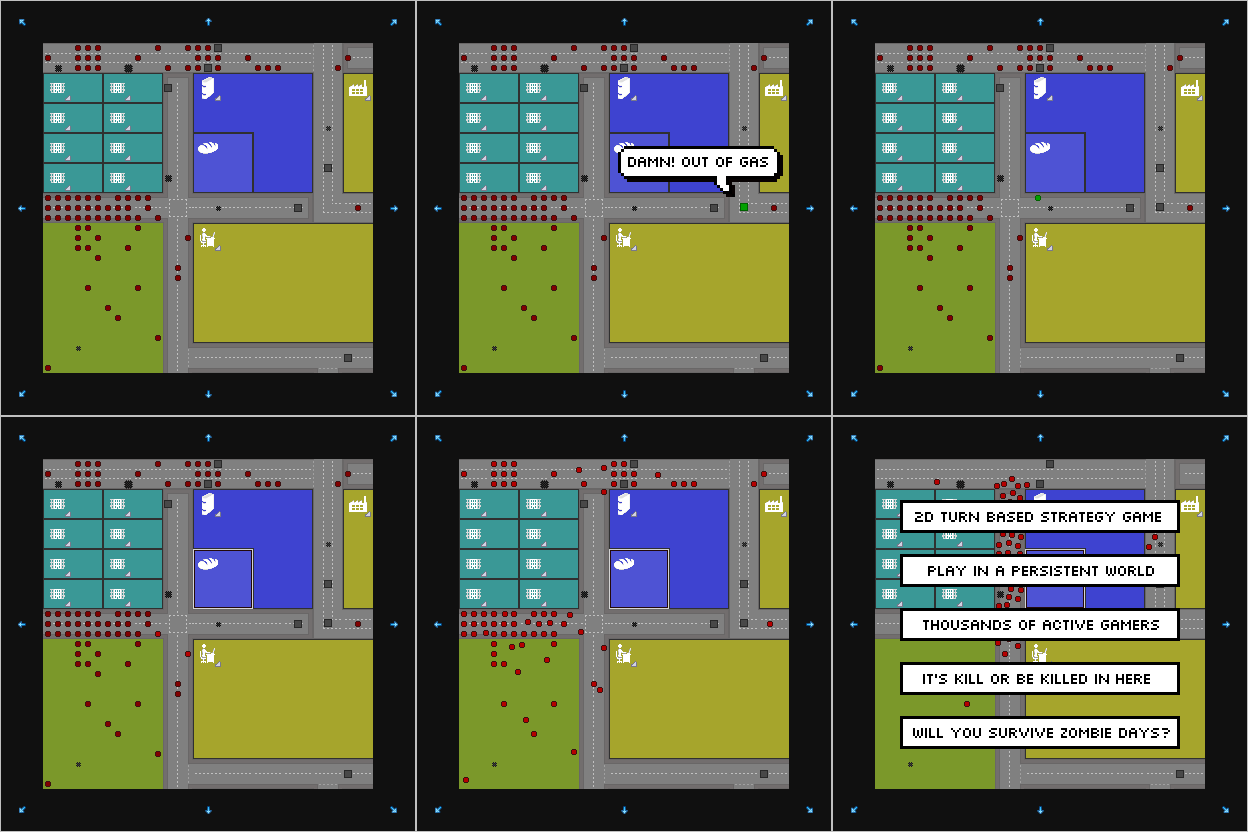
Zombies are slow, and they listen. They act on a slow clock, wander when there’s nothing to hear, and walk toward the loudest recent noise when there is. Crowds should form by themselves: one loud sound pulls a lot of them to the same spot. Dead players are the most dangerous zombies on any street, because they carry real gear.
What you carry
Two kinds of stuff. What you wear stays on your zombie. What’s in your pack drops where you died. Armour takes hits until it breaks. Weight makes you louder and costs you more energy per step, so the person with the most stuff is the one everyone can hear coming.