I’m starting a game. Before I write any code I want to put down why, so that later I can check whether I built the thing I meant to build.
The reason is a game called Zombie Days. It was a browser game that ran from around 2011 to 2013, made by a small studio called Rebel Developers. Nothing to download and barely any graphics, just a page you kept open. The front page promised a city of 150,000 grids, 8,000 buildings to search, claim and barricade, other humans to trade with, and hungry cannibals to avoid. The site went dark years ago. This is what the Internet Archive still has of it.
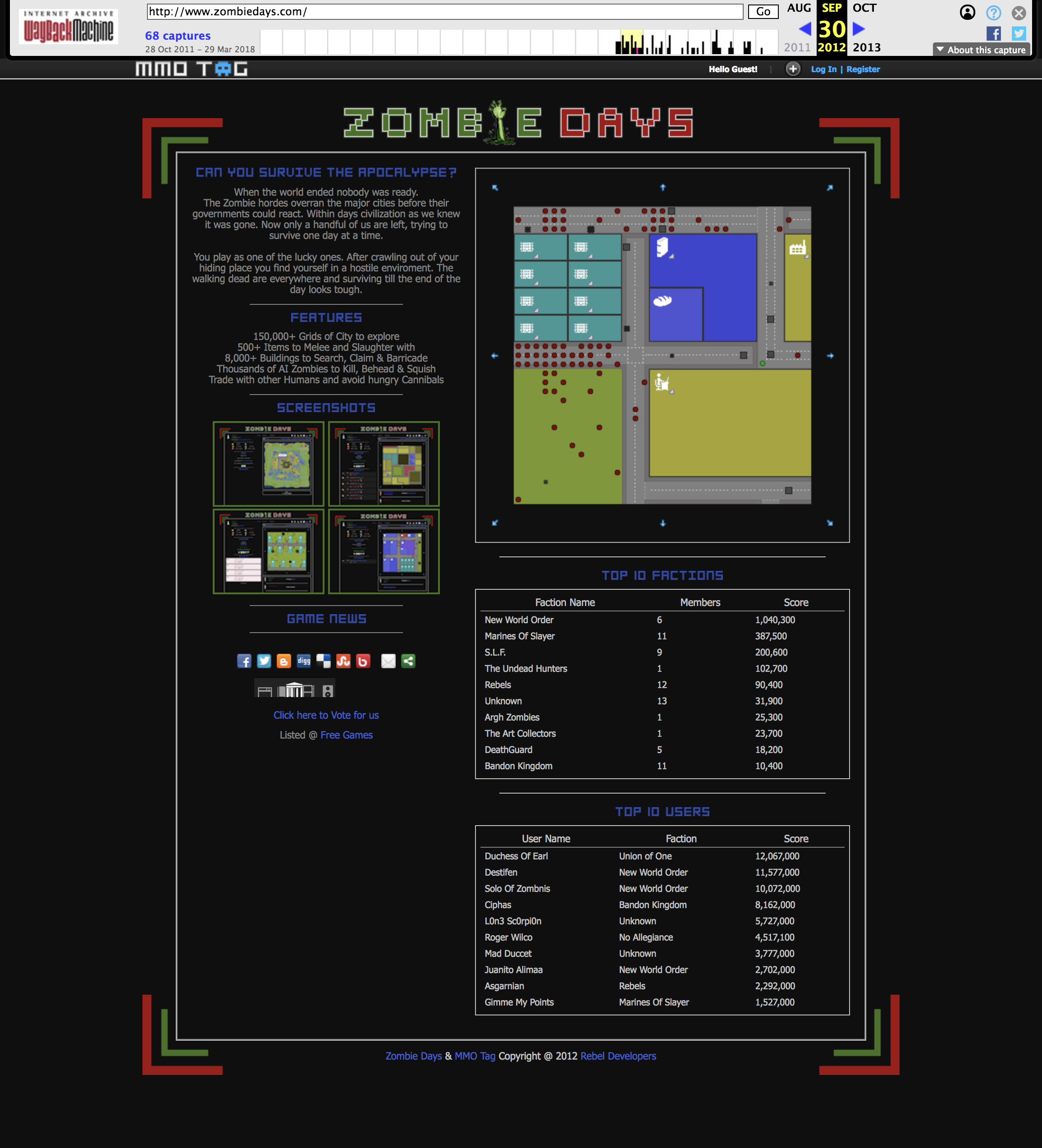
I played it all day, but never for long. I kept a tab open, checked on my character whenever I could, did a few things, then went back to work. Almost always on a desktop. The phone version was rough, and that’s one thing I don’t want to repeat.
What it got right
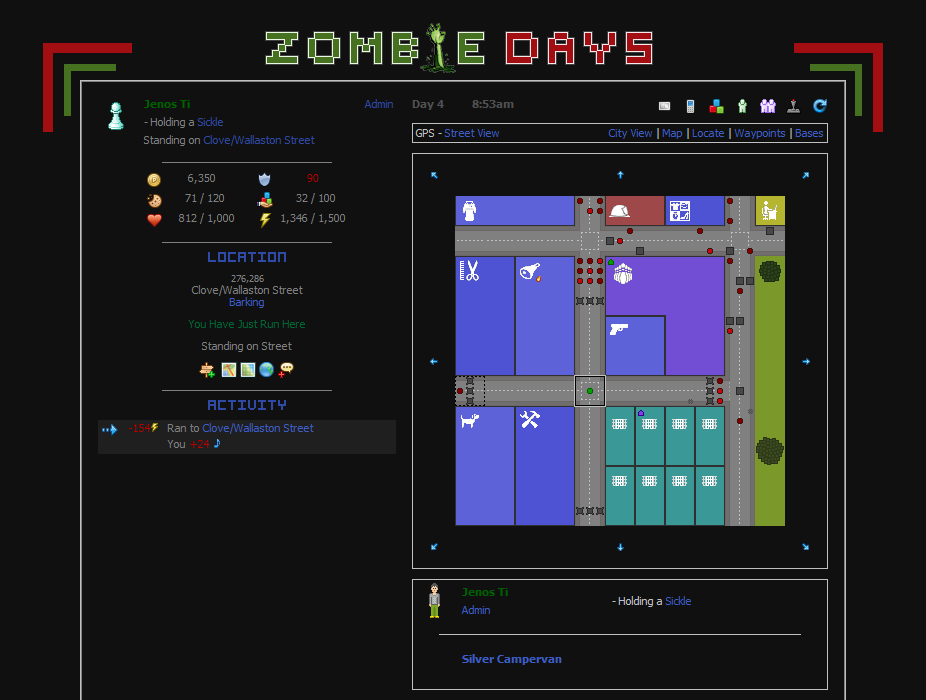
This is the map. A whole city seen from above, dense in the middle, countryside around the edge. Every street had a name. You stood on Clove/Wallaston Street and the game told you so.
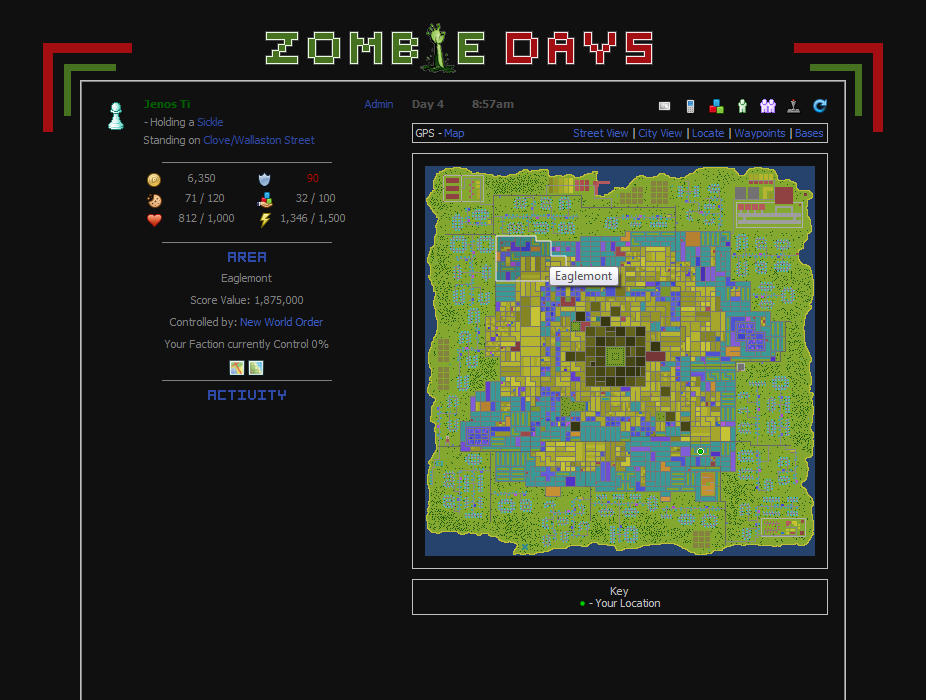
The city had a shape. The colors told you what a building was, so a block of shops looked different from a block of houses, and a park was a park. You could read the map like a real map and decide where to go. The center had the good stuff and the most zombies. The edge had less of both.
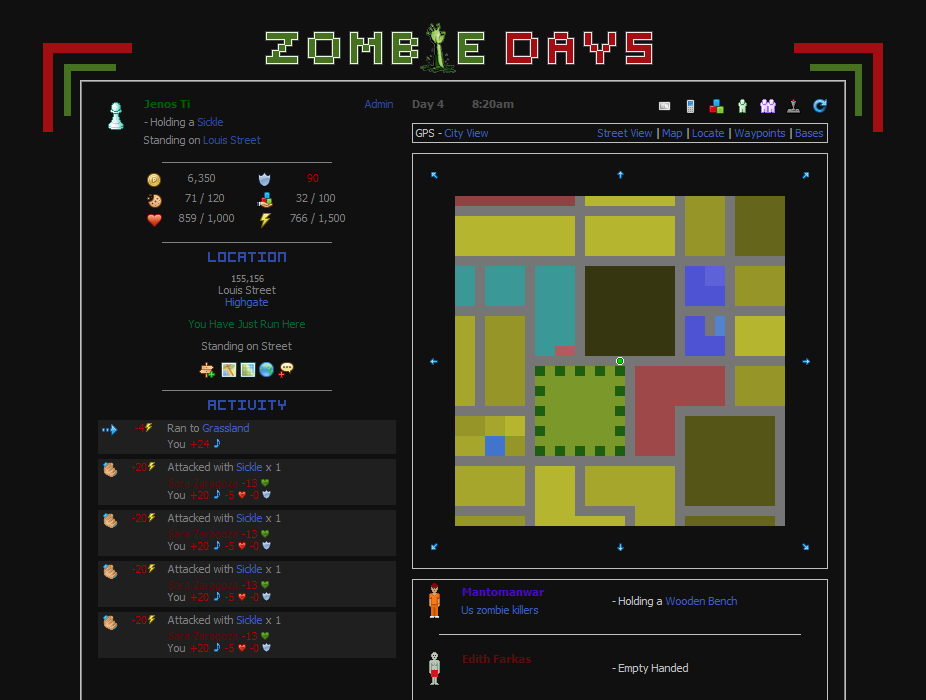
Everything cost energy. The lightning bolt in the stat block, 1,346 out of 1,500, was the real currency. Each step and each swing took some, and it only came back with time. You couldn’t grind for hours. You spent your energy and came back later, so every action was a small decision.
Zombies had names. In this fight the zombie is called Diana Morgan. She used to be somebody, and the game doesn’t let you forget it.
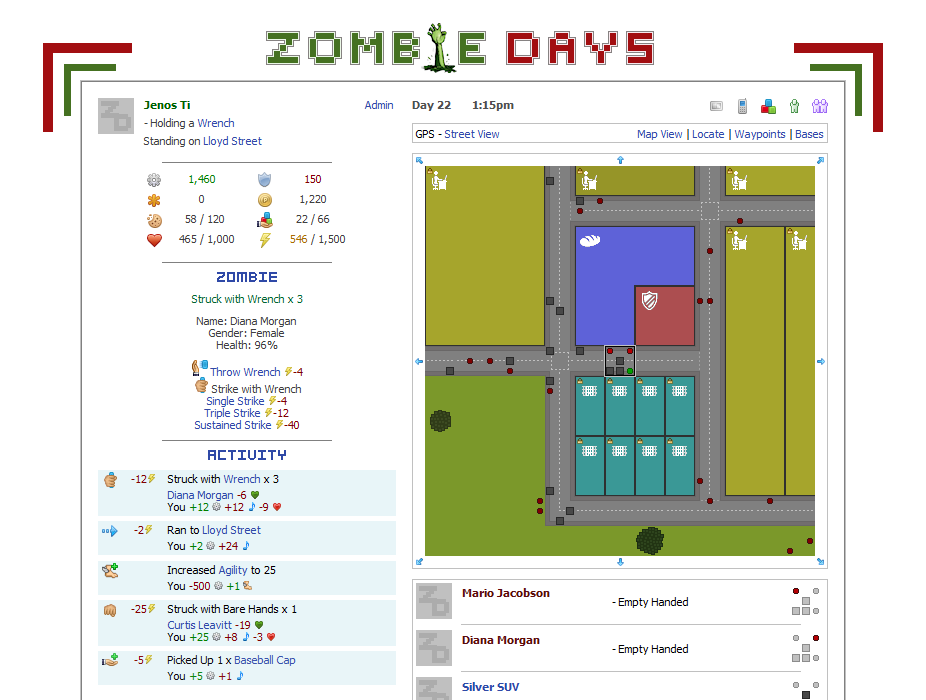
Underneath all of that, the world was shared and it kept running when you closed the tab. There were also factions and a leaderboard. I never cared for that part.
What was missing
Players, mostly. The city was huge and mostly empty. A game about other survivors needs other survivors, and most days I didn’t meet anyone.
On the design side, the thing that bothered me was that sound only went one way. Your actions made noise, and noise could bring zombies to you. But you never heard anything yourself. You couldn’t hear another survivor breaking down a door one street over. Past the street around you the world was silent.
What I want to keep, and what I want to change
I’m keeping the readable city, the energy, and the named zombies.
What I want to change is where the game puts its attention. The idea I keep coming back to is that every action makes noise, and noise travels. A gunshot carries across several blocks, and when someone else fires one, you hear it too. You see what’s in your line of sight, and beyond that you listen. Zombie Days had the first half of that rule. I want the second half, because a groan you can’t see coming is worse than a zombie you can. If it works, the numbers turn into choices: do I run or walk, do I break this door or look for one that’s open.
I don’t know if it works. It might just be noise nobody can make sense of.
One more rule to keep: your character stays in the world when you log off. Zombie Days did that, and it’s the reason I kept checking that tab all day. I want the same pull. I have no idea yet how to make it fair.