The last week went into one question: what does a room tell you before you spend energy on it? Until now the search button said “picked over” and that was the whole conversation. Everything else you had to remember yourself, which is a lot for a game you check in on from a bus. So the room became a thing you read.
One pile per room
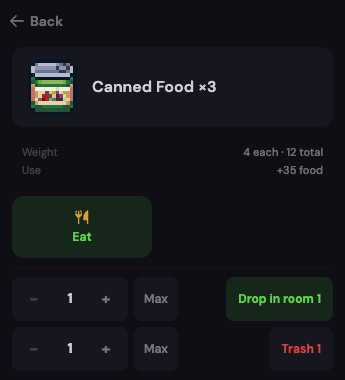
Indoors, a drop landed on the tile under your feet, so a lived-in house turned into dozens of separate little stashes, none of which said what it held.
Now everything you shed indoors goes to the room’s pile. What a search turns up and what you put down land in the same place, under the same magnifier. The drop button says so: indoors it reads “Drop in room”. A room holds a lot more than a street tile, because a room is where you would actually keep things.
The magnifier says three things
Every room already had a magnifier on the map, and it already dimmed once you had searched the room. That glyph now carries everything a room can tell you at a glance: bright or dim, for whether there is a search left in it; an amber ring around the outside, filling as the room recharges; and a bronze level inside, for how much of your own stuff is stored there. The level counts only what you put down, never what a search left.
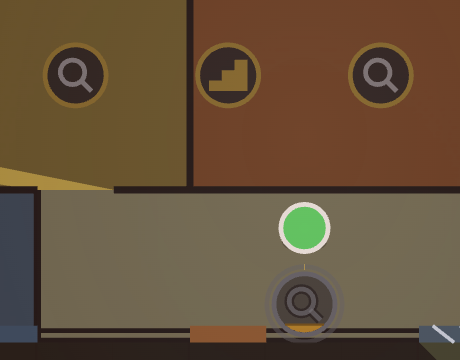
Walk in the front door and every room tells you in one look whether it is worth going back.
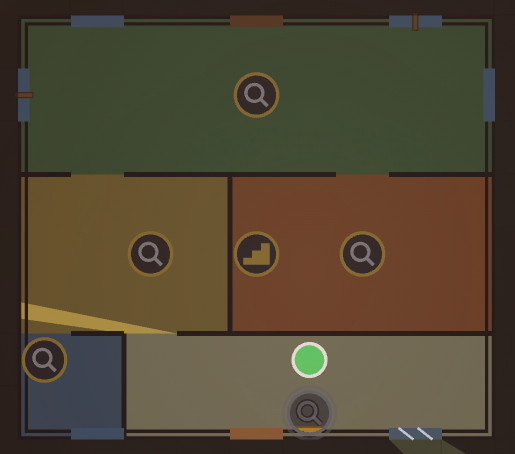
While I was in there I found three ways a room could lie about itself: a hall could be born already searched out, the menu counted the finds one way and the search another, and no room could ever read “well-stocked”. All three are fixed.
A room says what it can hold
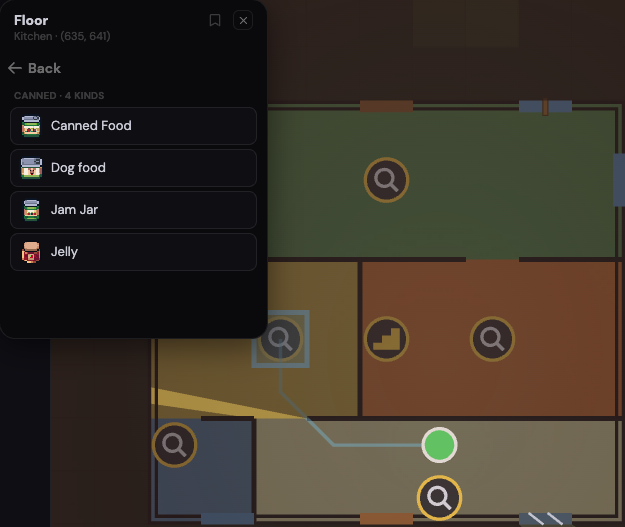
The game knew exactly what each kind of room tended to hold, and the player had no way to see any of it. So the search menu got one more line. Tap a room’s search spot and a quiet line reads “What a room like this holds”. Open it and you get the room’s list, most likely first.
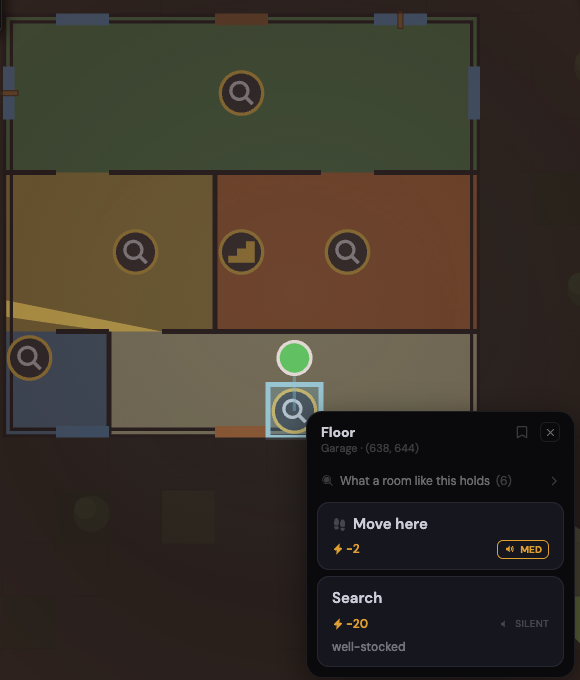
The rule I settled on is order, never odds. One search of a house kitchen turns up its best item about one time in thirty, a true number that reads as “you will find nothing here”. Nobody says “eleven percent canned goods”. They say “check the kitchen for cans”.
Things the table treats alike fold into one line, “Clothing, 19 kinds”, labelled by the most specific thing they share. Tap the line and every item behind it opens up, alphabetically, because they really are all equally likely. Junk stays off the list, except furniture, because a sofa is planks and planks are a wall.
Loot obeys the room now
Telling the player what a room holds meant the table had to be worth telling. It was not. A house kitchen could roll most of the game’s items, including twenty-five kinds of clothing, because the house said “clothing” at the building level and every room inherited it. So the table has a law now: an item may only be added to a room. A building, a district, a kind of shop can tilt what a room already holds, but none of them can put a thing on the floor of a room that has no business holding it. The house got a garage while I was at it, because its fuel and tools had been leaking into the kitchen. What the player sees is that a bathroom list says medicine and a workshop list says crowbar, and that when they search, the room agrees.
The list gives something away. Part of the pleasure of a house used to be not knowing what this one might hold, and now only the roll is left. I think that is the right trade for a game where every search costs energy that only time gives back, and I am keeping the odds to myself, which is the last piece of mystery the table has.