Three weeks ago the furniture went into the rooms as lettered tiles with a weight and nothing else. This week it became a thing you do something with: a sofa is not loot, a desk is a pile of planks waiting to happen, and every material in the game gets used up by something.
Faces, and hands
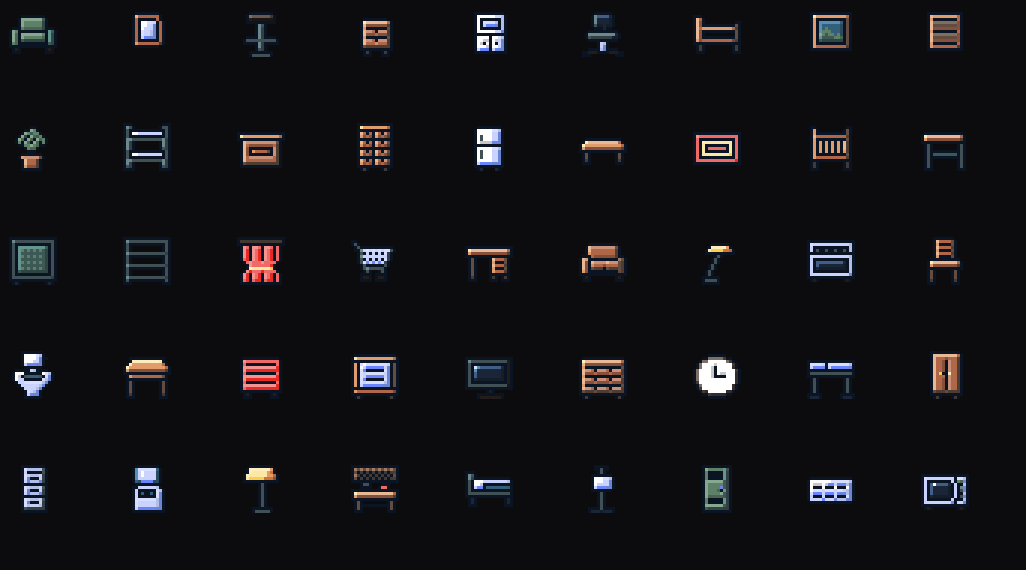
First the placeholders went away. Forty-five pieces got their icons, small and plain, so they sit next to a can of beans without looking like they came from a different game.
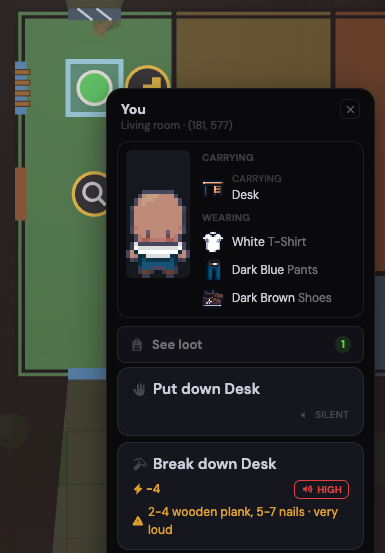
A piece of furniture never goes into your pack. You lift it, and it rides in your hands. Its weight lands on your load like anything else, so the overloaded rule is the only fence: lift a desk and you are past your limit at once, slow, walking only, paying extra energy for every step. Nothing stops you; the city just makes you feel it.
Hands full means hands full. You cannot fight, search, or board anything while you carry a piece. Die or log off and it drops where you stand. You can put it down, carry it to another room, or, from an upper floor with a window open, heave it out onto whatever is below. The heavier the piece and the higher the floor, the more it hurts.
Breaking it down
Nearly every piece of furniture, forty of the forty-five, carries a recipe for what it becomes. Wood breaks into planks and nails. Metal into scrap and screws. Cloth tears into rags. The menu names the yield before you commit, and greys the row out with the reason when you cannot do it.
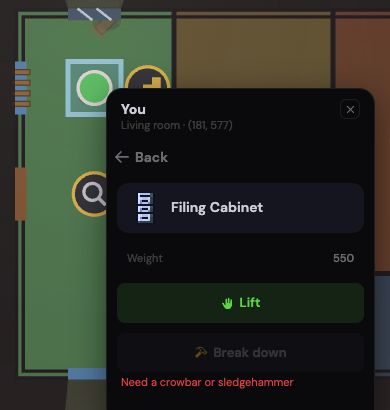
Wood wants something blunt, an axe, or a tool that demolishes. Metal wants a crowbar, a sledgehammer or a pickaxe. Cloth needs no tool at all; a sofa tears by hand. Wood and metal come apart in a timed job that bangs like a break-in every tick; cloth tears without a sound. Taking apart a desk in a quiet house is a choice about noise as much as about planks. Plain garments tear into rags too, straight from the pack, so a drawer of t-shirts is a stack of bandages waiting; armor is excluded.
Every material has a use
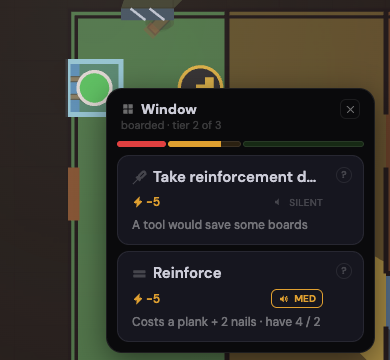
The materials existed before this week and mostly did nothing. Now each one is used up by something, and nothing is fixed by one material alone. A plank and nails take a board past the first grade. A metal sheet and screws board at twice the gain. Wire or rope lashes a free first board tighter. A rag is a bandage, a little health, nothing more. Duct tape and two scrap patch a weapon in your hand; duct tape and two rags patch the worst piece of armor you wear. Either gives a tenth back and neither can take a thing past half. Past half, the only fix is still cannibalising a spare of the same kind.
The first version of the tape patch, earlier this week, kept every weapon and every vest alive forever, which made durability decoration. Now a katana’s forty swings are a real budget.
The chainsaw
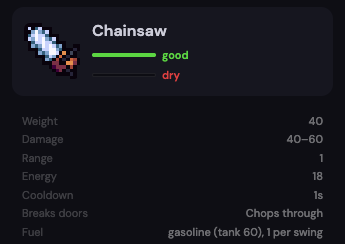
The chainsaw is now the hardest hitting melee weapon in the game. It one-shots the average walker, and it pays for that twice. Every swing screams like a break-in and pulls the dead toward you, and every swing drinks fuel. Dry, it is a slow, quiet club, and it cuts no furniture. A gasoline can comes part full depending on where you found it, near full at a gas station and dregs off a body, and gasoline lives where fuel is kept: gas stations, auto shops, warehouses, construction sites, farmhouses, and now and then a house.
A handful of tools, seven materials, and a recipe on nearly every piece of furniture. That is a crafting system, and this was never meant to be a crafting game. What I keep telling myself is that nothing here makes a new thing. You take a desk apart because you need planks for a window tonight, and the desk was in the room, and the planks were not. The day I catch myself adding a workbench that turns scrap into something better than scrap, I will know I have crossed the line.