The Buildings entry said a door is open, closed, locked or broken, and the Barricades entry said you can put planks on it. That was the whole door. This week it got everything else it was ever going to get, and one thing it isn’t going to get, which is the part worth writing down.
Keys, for two days
A door can be locked with a key. The key is an item: it lives in your pocket, it opens one door, it can be found on a body, it can be lost. I built it, and two days later I took it out.
Two things killed it. The first is the rule under every other rule in this game: a refuge is a delay, never a wall. If the key was in someone’s pocket across the city, or on a body that had already stood up and walked off, that door was shut for everyone else for good, and the only way in was a window. The Barricades entry said a door is a countdown. A key made it a seal.
The second is duller. Keys are fiddly. Find it, carry it, hide it, remember which door, lose it, argue about whether it dropped when you died. Every one of those is an inventory chore, and none of them is a decision about the street.
Barred from inside
Any opening, door or window, can be barred from the inside, for free, with nothing in your hands. A barred opening doesn’t open from either side until someone inside unbars it. That’s the whole lock. There is nothing to find and nothing to lose, and the only person who can lock the door is the person standing behind it.
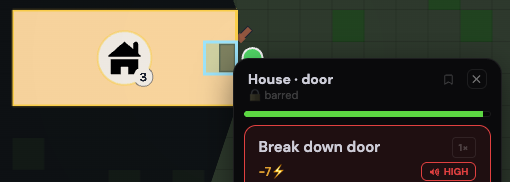
What makes it a lock and not a wall is that it has a strength. A barred door is a weak barricade: you can break it down from the street, it just takes a while and it’s loud, and the sheet tells you both before you swing. A barred window is thinner still, because glass is glass.
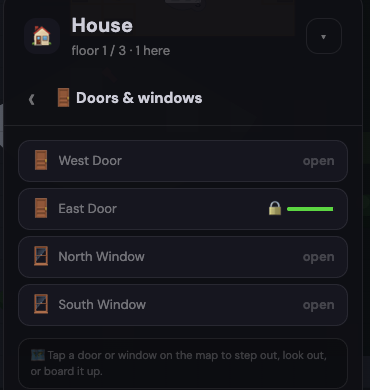
The difference from a key is who it’s for. A bar locks you in. You can’t bar a door and leave through it. If you want the house shut while you’re out, you board it and climb. Only the grades above the first cost planks. The cheap lock only works while you’re home.
Three grades, three ways through
Boards changed at the same time. An opening’s planks now fill in three grades, and you can read the grade from the street: a few planks, a solid job, a sealed vault. And there are three ways through a boarded opening. Climb: over a lightly or moderately boarded door, quiet, players only, no damage done. The dead can’t climb, which is why the lowest grade is worth anything at all. Pry: lever the planks off, quieter than a smash, with a crowbar recovering the wood and bare hands splintering it. Break: hit the boards with what you’re holding, loud, the only way through a sealed vault.
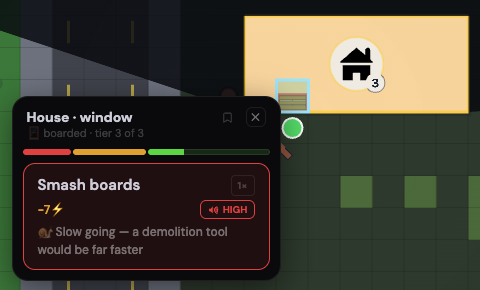
What you’re holding decides how the break goes. A sledgehammer or a pickaxe tears through. An axe chews. A bat is a bat. A knife barely marks the wood, worse than fists. A katana hits it harder but burns far more energy per swing, so the best fighter in the game is one of the worst burglars. The sheet says which kind you’re holding, in a line under the action, before you commit.
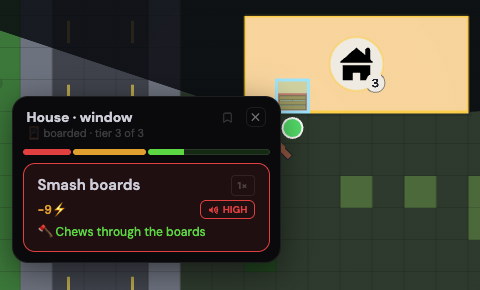
Windows and doors split here too. A boarded door can be climbed. A boarded window can’t, at any grade: you pry it or you smash it. And some buildings arrive already like this, barred and boarded on day one, so the city has places that were shut before you got there.
The bar is free and the boards are cheap enough that I expect every survivor to shut every door they sleep behind, and I want that. What I don’t want is a street of vaults. What keeps it from becoming one is that a bar breaks, boards break, and breaking is loud, so a locked-up street is a street full of invitations. Whether “worth locking” and “worth breaking” are balanced is the thing I got wrong with keys.